OutlookPart 3 of 7Science
We Are Still in the Stone Age
Our best materials, energy systems, and science will look primitive to the people who come next. The first clues to what replaces them are already sitting in data we have never properly read.
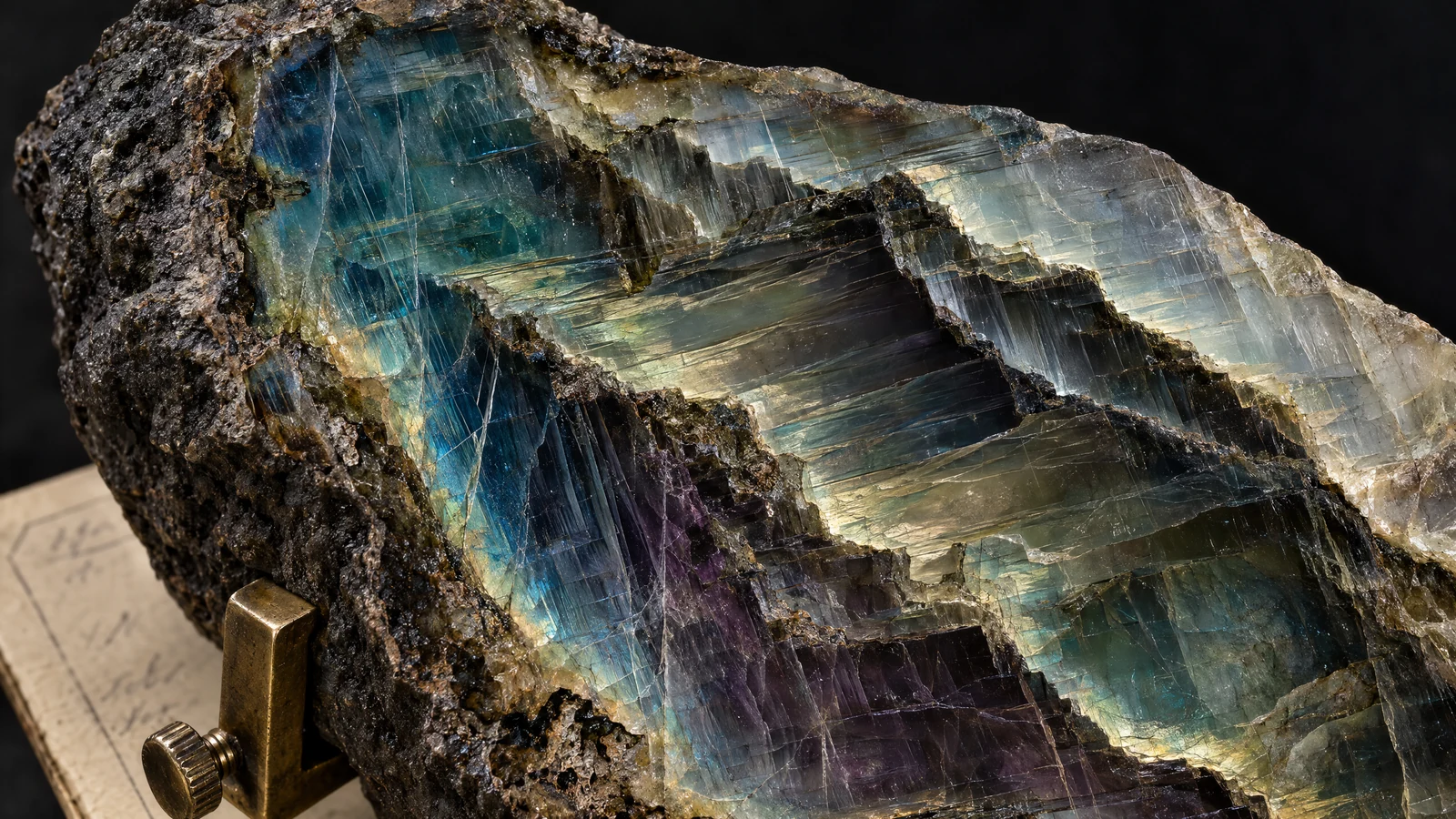
A modern economy is made of concrete, steel, copper wire, silicon wafers, and batteries built on a handful of minerals dug out of a few places on Earth. It runs on energy from burning things, splitting a few heavy atoms, or catching sunlight with panels that convert a fraction of it. It feels advanced because it is what we have, and every generation has felt the same way. To the people who come after the intelligence transition, our materials and energy systems will look like flint and firewood.
We are still in the Stone Age. I mean that as the most optimistic thing I can say about the future. Sheikh Ahmed Zaki Yamani, the former Saudi oil minister, made the old line famous: the Stone Age didn’t end for lack of stone.1 It ended because we found something better. A surprising amount of the next “something better” is already here, waiting to be read.
The unread library
Humanity now publishes more research than anyone could ever read. Peer-reviewed science and engineering output alone reached about 3.3 million articles in 2022.2 Add decades of experimental datasets, patents, engineering manuals, failure reports, and operating logs from every plant, mine, and grid on the planet. Most of it was read once, by a few specialists in one field, and filed away. It has been waiting ever since for a reader big enough to connect the dots.
The connections that matter most often sit between fields. A corrosion result buried in a mining journal might solve a battery-degradation problem. A protein insight might matter to a materials chemist. An anomaly one lab dismissed as noise might match a pattern another lab published a decade later, in a different language. No single expert can hold all of that in their head, and nobody had the time to look.
Now something can. In 2025, researchers at Imperial College London tested Google’s AI co-scientist on a question they had spent years answering in the lab but hadn’t yet published: how a family of bacterial genetic elements jumps between species. The system worked only from the public literature.
≈2 days
was all it took for the system’s top-ranked hypothesis to match the lab’s unpublished answer: the elements hijack the tails of other viruses.3
It was a rediscovery, not a new finding, and that is what makes it telling. The answer was already latent in what had been published. It needed only something that could read all of it at once.
Running new intelligence through the old record is the cheapest discovery humanity will ever do. The experiments were already paid for. We just never finished reading the results.
The candidate explosion
The first maps are already enormous. AlphaFold has made more than 200 million protein-structure predictions openly available, a map of biology no lab could have assembled one structure at a time.4 Google DeepMind’s GNoME project reported 2.2 million new crystal structures, 381,000 of them predicted to be stable, a vast expansion of the search space for new materials.5
Multiply that by everyone who can now do this kind of work. As the floor rises (see The Floor Just Moved), the number of intelligence-users, humans equipped with AI plus the agents working for them, is exploding. Each one can search the literature, generate designs and schematics, run simulations, and propose experiments that once took a funded research group.
Governments have noticed. In November 2025 the United States launched the Genesis Mission, directing the Department of Energy to build a national platform that joins federal supercomputers, AI models, and what the order calls the world’s largest collection of federal scientific datasets.6 By July 2026, more than 15 agencies had committed over $5 billion, and NASA and DOE were pointing it at more than 150 petabytes of data from telescopes, orbiters, landers, and satellites.7 A nation has decided that its archive is a strategic asset.
The result is a flood of candidates — new materials, molecules, circuit designs, process conditions, and engineering concepts — arriving faster than anyone has ever been able to evaluate them. Most will fail, and some headlines oversold the haul. When two materials chemists sampled GNoME’s stable list, they reported “scant evidence” of compounds that were at once novel, credible, and useful; many were trivial adaptations of known materials.8 A material that is “stable” in a simulation may be impossible to synthesize, too impure to use, or useless under real temperatures and loads, just as a predicted protein structure is a strong hypothesis rather than a measurement. The critique is an argument for better testing, not for searching less.
Predicted is not the same as made
- 2.2 million new crystal structures reported
- 381,000 predicted to be stable
- 736 independently realized in experiments
Areas are proportional to counts. The stable predictions are entries on a computed stability landscape, not synthesized materials.
Source: Merchant et al., Nature, 2023. Note 5
The bottleneck moves to the lab
When ideas are cheap, testing becomes the scarce resource.
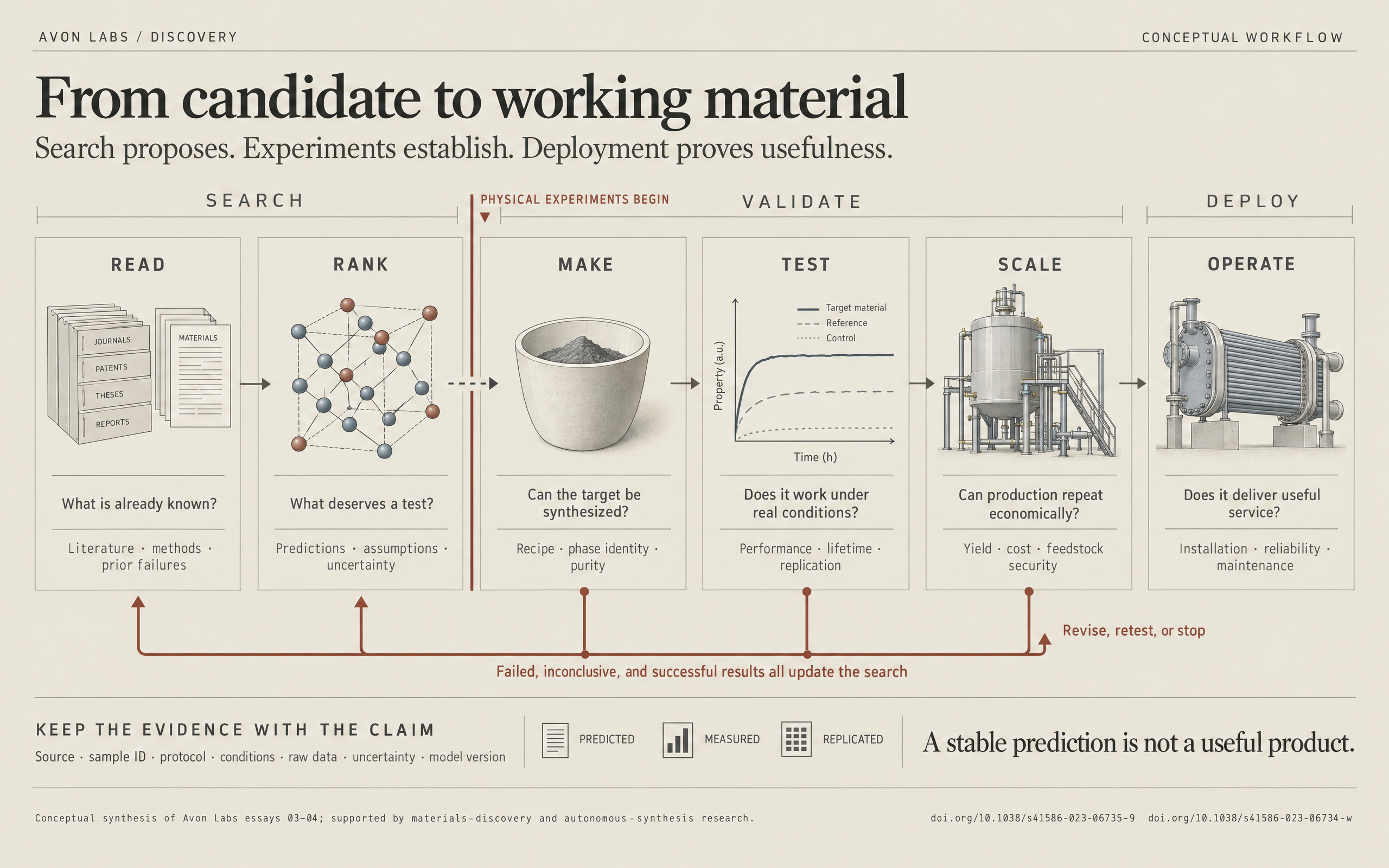
Every promising candidate has to survive a sequence of increasingly expensive questions. Can it be made at all? Can it be made pure? Does it survive real-world conditions? Can it be made consistently, at a reasonable cost, from feedstocks that actually exist? Does anyone need it badly enough to pay?
From candidate to working material
 Open full-size graphic
A conceptual map of discovery, not a measured conversion funnel. Stages can overlap and repeat; the experimental trace is illustrative.
Source: Merchant et al., Nature (2023); Szymanski et al., Nature (2023, corrected 2026). Note 5
Read the graphic
Read: establish what is already known from literature, methods and prior failures. Rank: choose what deserves a test using predictions, assumptions and uncertainty.
Make: establish synthesis, phase identity and purity. Test: measure performance, lifetime and replication under real conditions. Scale: evaluate repeatable production, yield, cost and feedstock security. Operate: demonstrate useful service through installation, reliability and maintenance.
Failed, inconclusive and successful results all update the search. Revise, retest or stop. Keep the source, sample ID, protocol, conditions, raw data, uncertainty and model version with each claim, and distinguish predicted, measured and replicated evidence.
Each question needs physical infrastructure: laboratories, instruments, technicians, pilot lines, test rigs, and people with enough domain expertise to know whether a measurement means what it seems to mean. In an intelligence-rich economy these become critical infrastructure, as strategic as data centers. The Genesis Mission’s own plan includes building autonomous laboratories alongside the models;7 the people writing the national strategy already know where the queue forms.
A few principles separate a discovery machine from a noise machine:
- Design experiments that change decisions. The best test is the one that kills a bad idea cheaply or earns a good idea its next round of funding.
- Record the failures. A failed experiment is data. Logged properly, it stops the next thousand agents from proposing the same dead end.
- Keep the provenance. Know which results were measured, which were simulated, and which were guessed. Confusing the three is how hype gets built.
- Close the loop. Experiments improve the models, better models propose better experiments, and the cycle speeds up. The whole loop moves at the pace of its slowest stage, and today that stage is almost always the physical one.
After the Stone Age
I don’t know what the next era’s defining materials or energy sources will be. If we could predict them, they’d already be here. What I am confident of is that the space of what’s possible is vastly larger than the space of what we use, and that we now have tools to search it at a pace that was unthinkable five years ago. New materials, new sciences, and new energy are coming, and many of their first clues are already sitting in our archives.
Every one of them will have to pass through the physical world. Simulations run on compute, and compute runs on power. Experiments need samples, instruments, and fabrication. Every result worth keeping has to be built, installed, and maintained.
The more we discover, the more we have to build.
Sources
All statistics and sources below were re-checked against primary or official pages on 9 November 2026. The GNoME critique, the co-scientist result, and the Genesis Mission are new to this edition.
- 1
Quote Investigator, The Stone Age Did Not End Because the World Ran Out of Stones, 7 January 2018. Yamani used the line in a June 2000 Telegraph interview and is the name most often attached to it; the earliest known version is Shell’s Don Huberts in The Economist, July 1999.
- 2
National Science Board / NCSES, Publications Output: U.S. Trends and International Comparisons, Science and Engineering Indicators 2024, December 2023. Counts Scopus-indexed S&E articles; excludes preprints and working papers.
- 3
Juraj Gottweis, José R. Penadés, Tiago R. D. Costa et al., AI mirrors experimental science to uncover a novel mechanism of gene transfer crucial to bacterial evolution, Cell, 2025; companion experimental paper doi:10.1016/j.cell.2025.08.019. See also Google Research, Accelerating scientific breakthroughs with an AI co-scientist, 19 February 2025, which describes the result as a “re-discovery” test.
- 4
Google DeepMind and EMBL-EBI, About the AlphaFold Protein Structure Database. “Over 200 million” computational protein-structure predictions.
- 5
Amil Merchant et al., Scaling Deep Learning for Materials Discovery, Nature 624, 80–85, 29 November 2023. The 381,000 figure counts new entries on the computed stability landscape, not synthesized materials; the paper reports 736 independently realized in experiments.
- 6
The White House, Launching the Genesis Mission, Executive Order 14363, 24 November 2025.
- 7
The White House, Trump Administration Announces More Than $5 Billion for the Genesis Mission, 22 July 2026. Commitments span more than 15 agencies; DOE, HHS, NSF, and NIST are to build autonomous laboratories.
- 8
Anthony K. Cheetham and Ram Seshadri, Artificial Intelligence Driving Materials Discovery? Perspective on the Article: Scaling Deep Learning for Materials Discovery, Chemistry of Materials 36(8), 3490–3495, April 2024. Based on a random sample of the stable set; Google DeepMind stood by its claims.