OutlookPart 4 of 7The physical economy
Intelligence Runs on Atoms
Cheaper intelligence won’t shrink the physical economy. It will grow it. Strip away the abstractions and everything comes down to three inputs: materials, energy, and intelligence.
The popular story about AI is that it makes things cheaper: cheaper code, cheaper reports, cheaper customer service, fewer people doing the same work. That story is true and incomplete. It treats the economy as a fixed pile of tasks waiting to be automated, and economies don’t work that way. When something important gets radically cheaper, we don’t do the same amount of it for less. We do far more of it.
In 1865, William Stanley Jevons argued in The Coal Question that more efficient steam engines would not save Britain’s coal. They would burn more of it, because efficiency made coal worth using in a thousand new places. To assume that saving fuel meant using less of it was, he wrote, a confusion of ideas.
“The very contrary is the truth.”
Intelligence is running the same experiment, and the first results are in. The IEA reports that the energy used per AI task has been falling by at least an order of magnitude a year, a pace of efficiency gain it calls unprecedented in energy history. In 2025, electricity use by AI-focused data centers rose 50%.2 Energy per task fell roughly tenfold and total use still rose by half. That is Jevons, in real time.
Jevons, in real time
The IEA calls the per-task efficiency gain unprecedented in energy history; total use still rose.
Source: International Energy Agency, Key Questions on Energy and AI, 2026. Note 2
The demand cascade
This is the mechanism at the core of my outlook. More intelligence-users (humans with AI, plus the agents working for them) means more capacity to engineer, prototype, research, and do science. That produces more designs, schematics, simulations, and proposed experiments than the world has ever seen. And every one worth pursuing creates demand for physical things:
A small engineering team that could once afford to explore one heat-exchanger design can now explore a hundred. Simulation kills ninety. The survivors, plus applications nobody would have bothered to investigate before, become prototypes, then products, then orders for steel, copper, power, and the people who install it all. Cheaper intelligence expands total activity and demand; it doesn’t just make existing work cheaper.
Thought is getting cheap. Atoms are not. That is where the opportunity lives.
Efficiency does cut both ways. Better simulation eliminates prototypes, better design uses less material, and some AI will simply replace existing work and create nothing new. The IEA itself says AI’s energy future depends on efficiency, uptake, and capability together, not on any one of them,2 so this is an opportunity thesis, not a law of physics. I’d still bet on Jevons. Every time we’ve made a fundamental input radically cheaper, we’ve ended up using more of it, and the first hard data from AI points the same way.
Energy: the first wall
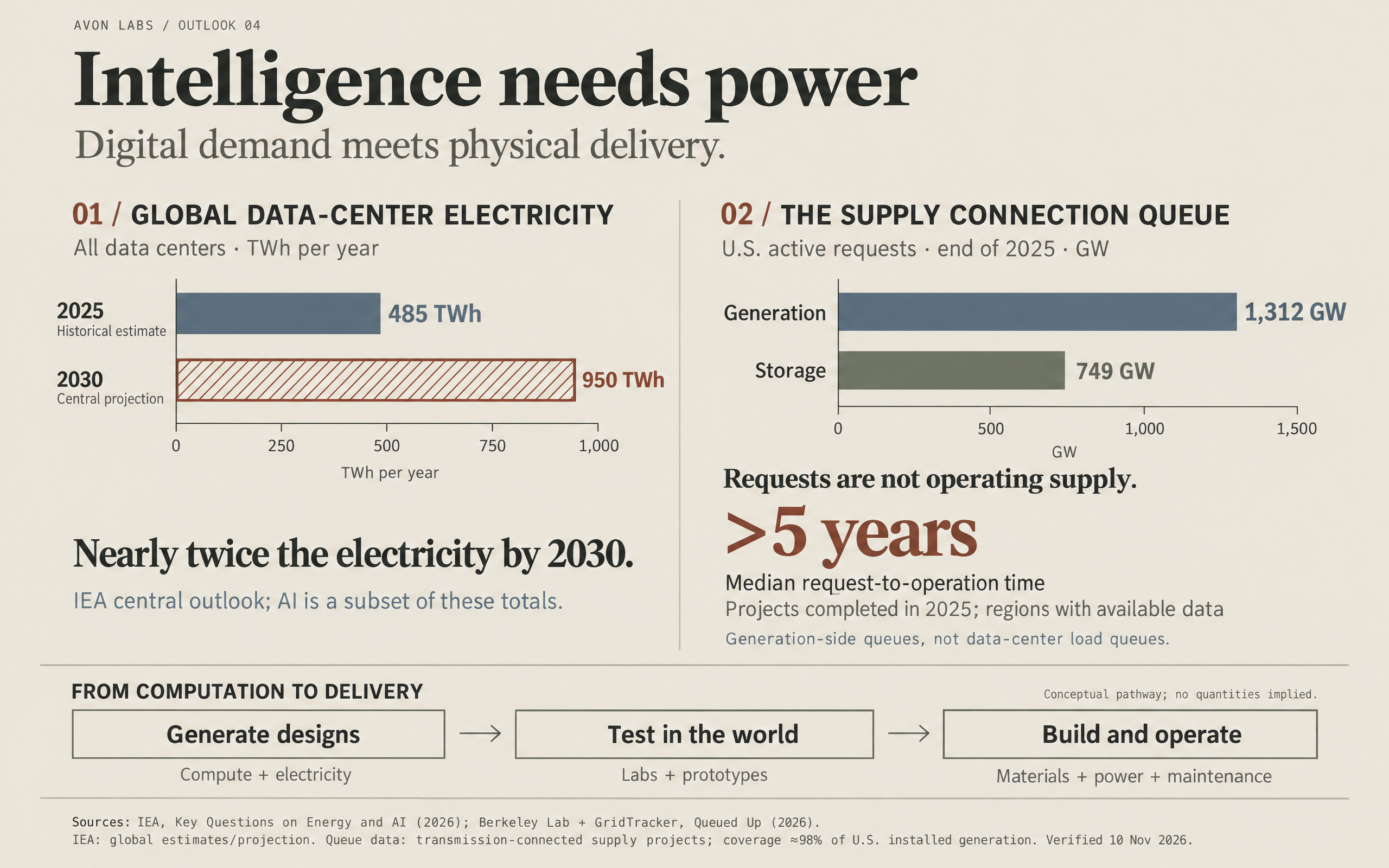
The first physical constraint is already here. The IEA estimates that data centers worldwide used about 485 terawatt-hours of electricity in 2025, up 17% in a single year, and projects roughly 950 TWh by 2030, around 3% of global electricity demand.2 That’s the compute alone, before the factories, labs, and industrial processes that successful AI-enabled work will eventually need.
Those totals understate the problem, because energy is a delivered service. It has to show up at a specific address, at the right time, at reliable quality and an acceptable price. That takes generation to make the power, storage to hold it until it’s needed, and transmission to carry it from where it’s made to where it’s used.
The connection is where the system is choking. At the end of 2025, U.S. interconnection queues held about 1,312 gigawatts of generation and 749 GW of storage, roughly 2,060 GW in total and well above the entire installed U.S. power-plant fleet of about 1,374 GW. Most of it will never be built: of the capacity that asked to connect between 2000 and 2020, only 13% was operating by the end of 2025. The median project completed in 2025 took 61 months, about five years, from request to operation.3
Intelligence needs power
 Open full-size graphic
Electricity use and queued capacity have different units and scopes. Queue requests are not operating supply; the waiting-time measure concerns generation projects, not data-center load connections.
Source: IEA, Key Questions on Energy and AI (2026); Berkeley Lab + GridTracker, Queued Up (2026). Note 3
Read the graphic
Worldwide electricity use by all data centers: 485 TWh in 2025 (historical estimate) and 950 TWh in 2030 (IEA central projection). AI-focused facilities are a subset of these totals.
Active U.S. transmission interconnection requests at the end of 2025: 1,312 GW of generation and 749 GW of storage power capacity. These are requests, not installed supply or stored energy. The dataset covers operators representing approximately 98% of installed U.S. generation.
For projects completed in 2025, the median time from request to operation exceeded five years in regions with available data. This does not measure data-center connection waits.
Conceptual delivery pathway: generate designs with compute and electricity; test them in labs and prototypes; build and operate with materials, power and maintenance. No quantities are implied by this pathway.
A design can be generated in an afternoon. The power to build it can take five years to connect.
That gap is the defining mismatch of this era, and it is why powered land has become one of the scarcest assets in the country. I don’t mean acreage near a substation, or a queue position with a good story attached. I mean sites with real, deliverable megawatts (15, 50, 100 and up) that can be energized on a schedule a tenant can actually underwrite. The market is pricing that in. Held back by slow grid connections, U.S. data-center developers are building their own onsite gas generation, even though the IEA finds reliable onsite power means overbuilding by 30% to 70%, and a 70% jump in gas-turbine orders in 2025 has created a chokepoint of its own.2 When buyers would rather build their own power plant than wait for the grid, ready megawatts are the product.
Materials: cheap isn’t the same as secure
Every design eventually becomes a bill of materials: what elements, what purity, what quantity, from where. Follow that list backward and you arrive at mines, refineries, chemical plants, and shipping lanes.
Price can lie here. In its 2025 outlook, the IEA found that the top three refining countries’ average share of key energy minerals had risen from about 82% in 2020 to 86% in 2024, while lithium prices had fallen more than 80% since 2023 and graphite, cobalt, and nickel had slipped too.4 Cheap and concentrated is a fragile combination. An input is affordable right up to the day it isn’t.
That day came fast. A year later, the IEA’s 2026 outlook reported that prices of aluminium, copper, and tin had risen by about a third between January 2025 and April 2026, with copper at record highs. Cobalt rose around 130%, largely because the Democratic Republic of the Congo restricted exports. Refining concentration hit new records, and investment in critical minerals fell 9% in 2025.5
I read that as a work order, not a reason for gloom: new extraction and separation methods, recycling, substitution, process control, and designs that get the same performance from less material. Concentration can be broken, too. In rare earths, new U.S. projects and growth in Malaysia cut the top supplier’s share of refining from over 90% in 2023 to 85% in 2025.5 Here the discoveries in We Are Still in the Stone Age start to pay off, because a better material only matters if you can make it from inputs you can reliably get.
Robotics: where intelligence touches the world
Robots are how intelligence reaches into the physical world and moves atoms around, and the installed base is large and accelerating.
603,000
industrial robots were installed worldwide in 2025, up 11% and above 600,000 for the first time. The operating stock passed five million.6
These are mostly industrial arms, not general-purpose humanoids, but they show how much of the world’s making is already automated.
The next leap depends on robots that work reliably through a full shift: handling awkward objects, recovering from faults, inspecting their own work, and needing a human far less often. A robot that does the task in a demo but calls for help every twenty minutes hasn’t removed the bottleneck. It has moved it. When robotics gets this right, the loop closes: intelligence designs the thing, robots help build it, and sensors feed real-world data back into the models.
Back to basics
When intelligence becomes abundant and money stops being the main constraint, what’s left is the foundation everything else stands on.
Materials and energy, paired with intelligence, are everything.
Intelligence tells you what to build, energy makes it run, and materials make it real. The companies, regions, and countries that control reliable access to all three will set the pace for everyone else.
None of the three puts itself to work. Someone has to build the transmission line, run the refinery, wire the data center, maintain the robot, and take responsibility when the plan breaks. That is where the real shortage is.
Sources
All figures were checked against the primary sources below on 9 November 2026. The interconnection-queue and robotics figures were updated to the latest editions (LBNL Queued Up 2026, IFR World Robotics 2026). The IEA 2025 minerals figures are kept as a historical baseline next to the 2026 update. The heat-exchanger team is a hypothetical illustration.
- 1
William Stanley Jevons, The Coal Question, 1865, Chapter VII, “Of the Economy of Fuel.”
- 2
International Energy Agency, Key Questions on Energy and AI — Executive Summary, 16 April 2026. Figures cover all data centers; 2030 is a central projection. The per-task efficiency figure is the IEA’s characterization of recent years. The onsite-gas, overbuild, and turbine-order figures come from the same summary.
- 3
Lawrence Berkeley National Laboratory and Interconnection.fyi, Queued Up: 2026 Edition, June 2026 (data through the end of 2025). The fleet comparison uses EIA-860 installed capacity, December 2025. The 61-month median covers projects completed in 2025 in regions with available data. Queue requests are not operating capacity, and most withdraw.
- 4
International Energy Agency, Global Critical Minerals Outlook 2025 — Executive Summary, May 2025.
- 5
International Energy Agency, Global Critical Minerals Outlook 2026 — Executive Summary, 16 July 2026.
- 6
International Federation of Robotics, World Robotics 2026: Industrial Robots — Executive Summary, September 2026. 603,307 units installed in 2025; operational stock 5,079,078.