OutlookPart 5 of 7The workforce
Money Is Not the Bottleneck
There is more capital chasing the future than there are people able to build it. The scarcest resource of this era is the operator: the person willing and able to do the work.
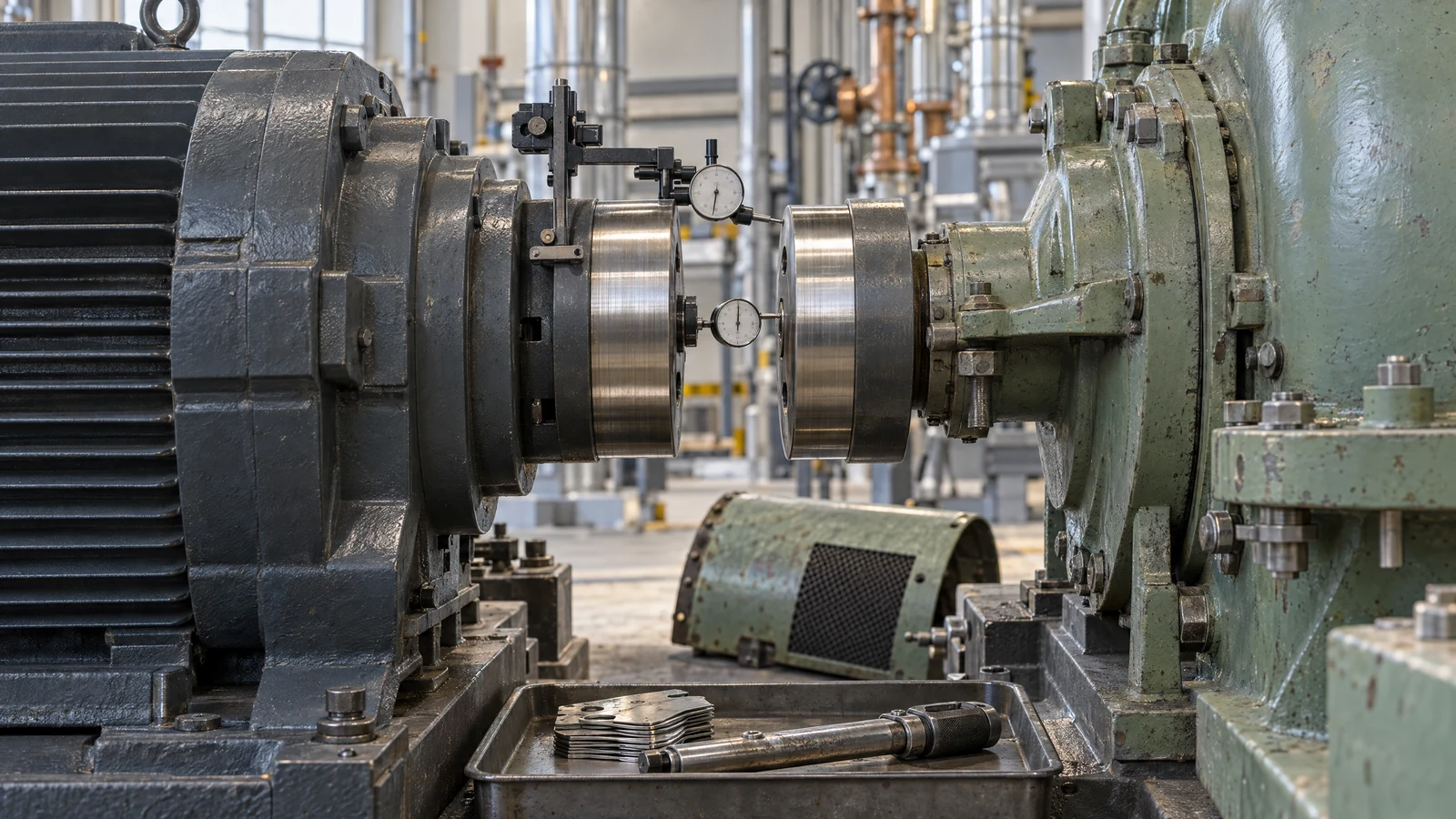
Ask anyone trying to build a data center, a factory, a grid connection, or a new production line what is actually holding them up. It’s rarely the check. It’s the transformer with a long lead time, the interconnection study, the permit, and above all the people: the project lead who can hold the whole plan in their head, the electricians to wire it, the technicians to commission it, the operator who keeps it running at 3 a.m. when something trips.
For most of modern economic history, capital was the gate. If you had the money, you could buy the land, the equipment, and the labor. In the parts of the economy that matter most right now, that is no longer reliably true. Money is in surplus. The people willing to do the work are not. Call it an infinite-money situation: the bottleneck is everything money can’t directly buy.
What “infinite money” means
$700B+
In 2026, Amazon, Alphabet, Microsoft, and Meta are guiding to more than $700 billion of capital spending between them, largely to build AI infrastructure.1
Four companies, one year. When Microsoft trimmed its forecast in October from $175 billion to $170 billion, the reason it gave wasn’t money. Outside providers were late delivering capacity, pushing some of it into 2027.1 The cash was ready. The capacity wasn’t.
None of this means every founder can raise whatever they want. In the Federal Reserve Banks’ latest survey of small employer firms, only 42% of financing applicants received the full amount they sought.2 Capital is still finite, still costly, and still unevenly distributed. The scarcity I mean is relative. Enormous pools of capital (corporate balance sheets, institutional funds, sovereign money, government programs) are hunting for credible places to go. What they can’t find fast enough is credible people to give it to: operators with a real plan, the skills to execute it, and a track record that makes the next dollar safe.
Seen that way, the 42% sharpens the point. Money isn’t scarce in general; it’s scarce for unproven execution. It flows, sometimes in floods, toward people who’ve shown they can turn a promise into a delivered result.
Money is no longer the main driver. Execution is.
The operator
An operator turns possibility into a finished thing. Operators find the real dependency, the one constraint that actually decides whether the project lives, and assemble the skills to get past it, inside the team or outside it. They set milestones that mean something, so each new dollar is earned by evidence and not by hope. And they own the result, staying accountable when the plan changes, which it always does.
AI makes good operators dramatically more powerful. One person can now research a market, model a project, draft the contracts, and track a hundred moving parts that once needed a staff. But AI can’t be the operator. It can’t take responsibility, and it can’t stand in front of an investor, a regulator, or a crew and say “this is on me.” As intelligence gets cheaper, the person willing to own the outcome gets more valuable, not less.
You can’t download an electrician
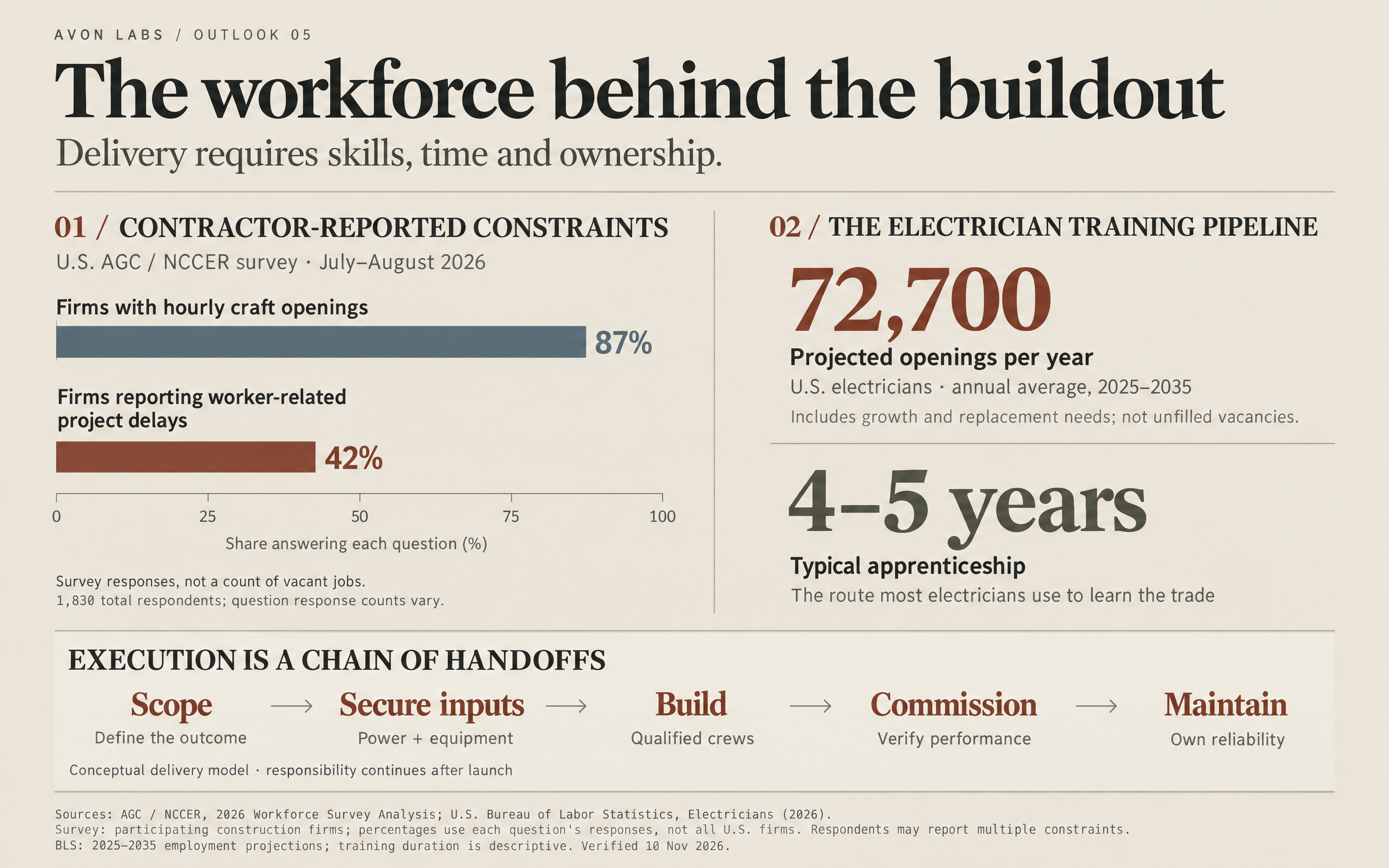
Below the operator is the workforce that physically builds the future, and here the shortage is acute and across the board. The 2026 workforce survey from the Associated General Contractors of America and NCCER puts it in plain numbers. Even with parts of the construction market softening, 87% of firms have openings for hourly craft workers, and 88% of those say the positions are as hard or harder to fill than a year ago. Half say the candidates who do show up lack the skills, certificates, or licenses to do the job. Worker shortages are the single most cited cause of project delays: 42% of contractors say a lack of their own or their subcontractors’ workers has held up their projects.3
Data centers are making it worse. Among contractors who worked on one in the past year, 58% say those projects have increased competition for skilled workers, and the availability of workers or subcontractors is their most cited challenge in winning and delivering the work.3 The buildings meant to hold all that capital are waiting on people.
The trade that wires them tells the story. The Bureau of Labor Statistics projects about 72,700 openings for electricians every year, on average, from 2025 to 2035, counting both new jobs and replacements for people who retire or leave, and most electricians learn the trade in a four- or five-year apprenticeship.4 An AI model can be updated in months. A new electrician takes half a decade.
The workforce behind the buildout
 Open full-size graphic
Survey percentages answer separate questions. Projected electrician openings include growth and replacement needs; they are not a count of current vacancies.
Source: AGC / NCCER, 2026 Workforce Survey Analysis; BLS, Electricians (2026). Note 4
Read the graphic
In the July–August 2026 AGC/NCCER survey, 87% of firms answering the relevant question reported hourly craft openings; 42% reported delays caused by shortages of their own or subcontractors’ workers. The survey had 1,830 participants overall, but response counts vary by question. These percentages are not estimates for all U.S. firms, and respondents may report several constraints.
BLS projects an average 72,700 U.S. electrician openings per year from 2025 through 2035, including growth and replacement needs. Most electricians learn through a four- or five-year apprenticeship; other routes exist.
Conceptual delivery model: scope the outcome, secure power and equipment, build with qualified crews, commission by verifying performance, and maintain reliability. Responsibility continues after launch; this sequence does not encode measured durations.
You can’t download an electrician.
The experiments, power lines, refineries, and robots that the intelligence economy depends on all run, eventually, through someone with a license, a toolbelt, and years of hands-on judgment.
“Shortage” is a slippery word, and it deserves scrutiny. A company that can’t hire at a given wage, in a given town, hasn’t proved there’s no one anywhere. Some of it is a pay problem, a conditions problem, or a training-pipeline problem, and it’s uneven across trades and regions. But contractors are already paying up: more than eight in ten raised base pay as much as or more than they did a year earlier, and craft jobs are still as hard or harder to fill.3 Raising wages can pull a skilled worker from one employer to another. It can’t create a new one on a deadline. If the real fix is status, training, and time, those are choices, and we’re not making them fast enough.
Make the work worth doing
If we want more physical work done, competence has to be worth acquiring and worth keeping:
- Pay and status. The trades should be one of the most respected paths a young person can choose, because they’re about to be among the most essential.
- Faster, better training. AI can help an apprentice learn diagnostics, read schematics, and find the right procedure in seconds. It can’t replace the hours of real work, but it can make every hour count.
- Tools that extend experienced people. Help with inspection, documentation, and diagnosis lets a master electrician supervise and teach more, instead of losing half the day to paperwork.
- Robots as partners, not replacements. The robotics in Intelligence Runs on Atoms will take the dull, dangerous, and repetitive work. Someone still has to install, program, and maintain them.
- Respect for maintenance. A system’s value comes from the years it runs, not the ribbon-cutting. The people who keep things running deserve as much credit as the people who build them.
Become an operator
When money stops being the constraint, you go back to what it was always standing in for. Capital is a claim on materials, energy, intelligence, and the people who can do the work. When the claims are abundant and the things are scarce, the advantage goes to whoever controls the things and to whoever can actually make them happen. Operators are how those inputs get combined.
So become an operator. Learn a hard skill. Take responsibility for a real outcome. Ship something physical. In a world drowning in capital, the person who can deliver is the scarce asset, and the money will find you.
The same arithmetic holds for a country. A nation’s ability to act depends on how many operators and skilled hands it has, how fast its institutions let them work, and whether it can build what it needs when it needs it.
Sources
Re-verified against the primary or publishing sources on 9 November 2026. The Fed and BLS figures were confirmed unchanged; the AGC/NCCER survey figures were checked against AGC’s own release and analysis; the hyperscaler capital-spending figures were added for this edition.
- 1
CNBC, Amazon posts negative free cash flow of $42.4 billion, holds 2026 capex unchanged (Amazon, about $220 billion), Alphabet sinks 10% as it holds 2026 capex unchanged (Alphabet, $195–205 billion), Meta Q3 2026 earnings report (Meta, $135–145 billion), and AI buildout hits snag as Google and Microsoft put off raising capex forecasts (Microsoft, cut to $170 billion from $175 billion; CFO Amy Hood cited delays at third-party GPU providers pushing some capacity into the first half of 2027), 21–29 October 2026. The combined total is my sum of company guidance; fiscal-year definitions and lease accounting differ by company.
- 2
Federal Reserve Banks, 2026 Report on Employer Firms: Findings from the 2025 Small Business Credit Survey, 3 March 2026. Share concerns firms with 1–499 employees that applied for financing; 6,525 responses, fielded September–November 2025, from a weighted convenience sample rather than a random sample.
- 3
Associated General Contractors of America and NCCER, 2026 Workforce Survey: National Release and 2026 Workforce Survey Analysis, 3 September 2026; summarized by NCCER, AGC: Construction Workforce Shortages Remain Acute Despite Soft Market Conditions, 3 September 2026. Fielded July–August 2026; 1,830 respondents answered at least one portion. Data-center figures cover the 28% of respondents who worked on a data-center project in the past 12 months.
- 4
U.S. Bureau of Labor Statistics, Electricians — Occupational Outlook Handbook, 2026 edition. Projected openings over 2025–2035 include growth and replacement needs; they are not a count of unfilled vacancies.